
A village by the broad water (until 1600)
Bredene grew up as a small village on higher ground in a landscape that was regularly flooded by the sea.
- The broad water: the name Bredene comes from breeden-ee, the broad water, referring to the Noordede, an old creek that now flows into the Spuikom.
- Saint Riquier (1087): the church of Bredene is first mentioned in 1087, as a priory of the abbey of Saint-Riquier; Sint-Rikier is still the patron saint of Bredene.
- On the highest point: the Sint-Rikierskerk stands on the highest point in the area, because the land was often under water.
- A medieval burial ground: in 1976, 25 skeletons dating from between 1365 and 1455 were found in the Fazantenlaan.
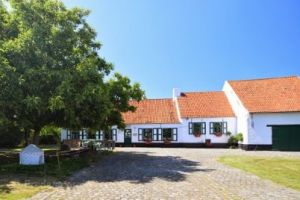
- Turkeyen farm: the farm where the Turkeyenhof now stands is already mentioned in 13th century charters and on the map by Pieter Pourbus from 1565.
The Siege of Ostend, the Fishermen's Chapel and Sas-Slijkens (1599 to 1800)
Because it lay next to Ostend, Bredene found itself in the middle of the war around 1600.
- A Spanish fort (1599): in 1599 the Spanish built a fort in Bredene with an earth rampart around the village, in preparation for the Siege of Ostend.
- The tower blown up (1600): when the troops of Maurice of Nassau advanced in 1600, the Spanish left the fort and blew up the church tower.
- Repair and fire: the church was repaired in 1627, badly damaged by fire in 1640 and enlarged in 1699 with two side aisles and a wooden bell tower.
- Sas-Slijkens (1676): in 1676 locks were built between the canal to Bruges and the port of Ostend; after they broke in 1752 a new lock complex with sawmills followed, and so the district of Sas-Slijkens grew up.
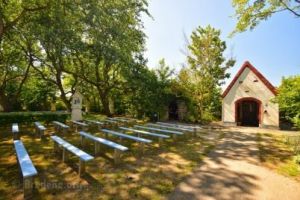
Farmers' tram and royal projects (1800 to 1945)
In the 19th and early 20th centuries Bredene remained a rural village, but new connections and institutions arrived.
- Border with Ostend (1807): in 1807 the border with Ostend was fixed; as the port grew, Bredene later lost parts of its territory to Ostend.
- A new church (1907): because the old church was dilapidated, it was demolished after 1871; the new Sint-Rikierskerk was completed in 1907.
- The farmers' tram (1886): in 1886 the steam tram from Ostend via Sas-Slijkens and Bredene village to De Haan and Blankenberge began running; it was electrified in 1909 and ran until 1955.
- Koninklijke Baan (1904): when the Koninklijke Baan coast road was built in 1904, the old district of Turkeyen disappeared, giving its name to the Turkeyenhof.
- Koninklijk Werk IBIS (1906): in 1906 Prince Albert, later King Albert I, founded the Koninklijk Werk IBIS in Sas-Slijkens, where fishermen's children received maritime training.
- The ballot: until 1910 a ballot decided who had to become a soldier; Bredene was the main town of a militia canton, and the ballot drum is now on display in the Turkeyenhof.
- A racecourse in the dunes: between the world wars there was a horse racecourse in what is now the D'Heye nature area.
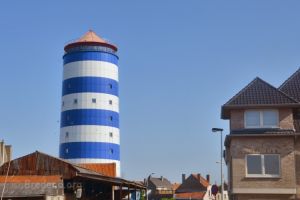
Dunes, campsites and seaside resort (1945 to today)
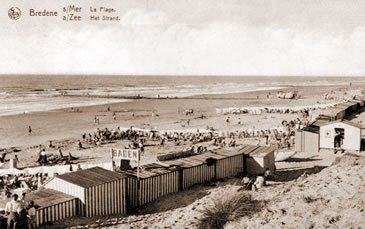
After the Second World War Bredene became a resort with a character of its own: no promenade, but an unbroken row of dunes and many campsites.
- Bredene-Duinen: the tourist centre of Bredene-Duinen has no promenade, but an unbroken row of dunes along the beach that is unique in Belgium.
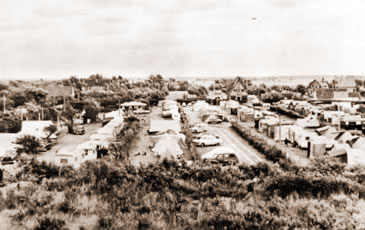
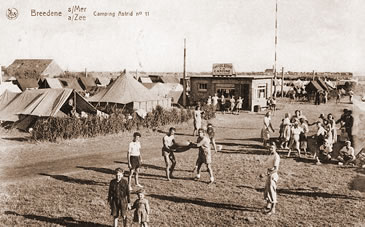
- Campsites: dozens of campsites lie between Bredene-Duinen and De Haan, making Bredene one of the big camping municipalities on the coast.
- Ter Cuere heritage society: the Ter Cuere local history society was founded in 1966 and since 1979 has run a museum on the history of Bredene in the Turkeyenhof.
- D'Heye (1993): the old inland dunes of D'Heye were protected in 1993 and are now part of the Natura 2000 area of the coastal dunes.
- Naturist beach (2001): since 2001 Bredene has been the only Belgian resort with an official naturist beach.
